
- Is Trekking in Nepal safe? (Reality vs Myths)
- Myth 1: Risky Pathways make people always fall
- Myth 2: It is permitted and simple to have solo adventures
- Myth 3: Elevation kills unequally
- Myth 4: Avalanches and quakes turn it into a dangerous place
- Myth 5: Rescue requires days or fails
- Myth 6: Theft, robbery high on trails
- Myth 7: Too strong or too costly equipment required
- Myth 8: You cannot take monsoon treks
- Myth G: Treks are affected by political unrest
- Essential Safety Checklist for 2026
- Real Stats: Safer Than You Think
- Conclusion: Yes, Safe with Smarts
Is Trekking in Nepal safe? (Reality vs Myths)
Have you been dreaming about Nepal mountains and are scared by frightening stories? When standing far away, trekking in Nepal seems to be a dangerous game, but upon closer examination, it proves to be a less risky affair. Every year, thousands of people summit successfully using guided trails.
They spread on the internet, but the low fatality rates confirm the truth. Safety is the priority of agencies such as Good Vibe Adventure, whose guides have more than 20 years of experience. Debunking builds confidence.
Myth 1: Risky Pathways make people always fall
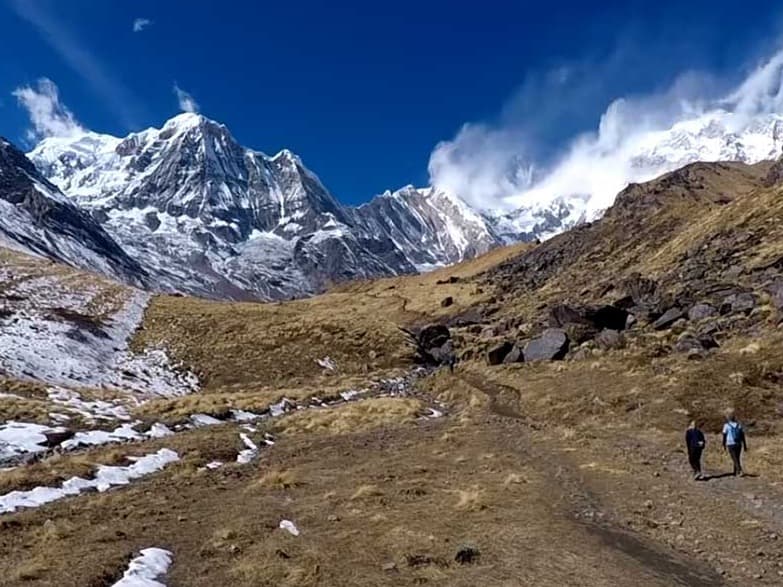
Reality: Narrow roads have few accidents. Ulleri stairs or steep Khopra ridges are a challenge, but poles and a slow pace work. Landslides are rare, not common outside the monsoon.
Guides avoid dangerous situations. By 2025, the injury rate on Annapurna is less than 0.5%. Stick to paths.
Good Vibe Pro Tip: Trekking poles reduce slip risk 50%; rent costs $5.
Trekking in Nepal: Is it safe? (Reality vs Myths)
Imagining the Nepalese mountains, but frightened by horror tales? Hiking in Nepal seems dangerous to look at, but in reality, it is a safe adventure. Every year, thousands of people summit successfully using guided trails.
Myths are propagated via the internet, but low death rates prove the reality. Safety is of high concern to agencies such as Good Vibe Adventure, where the agency has 20+ years of experience. Debunking builds confidence.
Myth 1: Dangerous trails make people fall all the time
Reality: Narrow roads have few accidents. Ulleri stairs, steep Khopra ridges are a challenge, but poles and slow pace work. Landslides are rare, mostly during monsoon.
Guides avoid hazards through rerouting. 2025 projections: the injury rate on Annapurna will be less than 0.5%. Stick to paths.
Good Vibe Pro Tip: Trekking poles cut slip risk 50%; rent for $5/day.
The rocky pass at Thorong La is crossed 10,000+ times annually with no problem.
Myth 2: It is permitted and simple to have solo adventures
Reality: Since 2023, Nepal requires foreigners in Everest, Annapurna, and Langtang to have a guide. Permits are denied for solo trekkers. This has cut missing cases.
Guides lead through fog and snow. Porter-guides can carry loads of 20 kg. Expenses are reasonable at $30/day.
Safety nets are created by groups.
Myth 3: Elevation kills unequally
Reality: Acute Mountain Sickness (AMS) occurrence is 40%; however, 95% recover on descending. HAPE/HACE are rarer at 1%. Oximeters monitor oxygen saturation.
Rules: 400m/day sleeping gain. Rest in Manaslu Samagaon. Diamox prophylaxis is common.
Most are prevented by hydration and carbs.
Base camps such as Annapurna help the body adjust in a gentle manner.
Myth 4: Avalanches and quakes turn it into a dangerous place
Reality: Trails rebuilt in 2015 are stronger with gabions. Avalanches affect climbers above 6,000m, not trekkers below 5,000m. Monsoon routes are shut down ahead of time.
Forecasts for 2026 will improve through satellites. EBC is safe post-2014 avalanche improvements.
Insurance funds diversions.
Insider Hack: TAAN app gives real-time notices of closures.
Myth 5: Rescue requires days or fails
Fact: 1,200+ heli rescues every year; response time 4–12 hours. Air Dynasty and Summit Air are on standby. GAMOW bags buy time.
Costs $4,000–12,000 per person; World Nomads covers. TAAN connects via teahouse radios.
Calm is developed through practice drills.
Myth 6: Theft, robbery high on trails
Fact: Theft on trails is near zero; porters are bonded. Kathmandu scams are directed towards tourists—use hotel vaults. Women say they feel safe in groups. Locals do not steal, but share meals. Advisory Level 2: be cautious, as used in the U.S.
Myth 7: Too strong or too costly equipment required
Fact: Average fitness is enough for Poon Hill. Porters take tents and food. Thamel rents full kits for $20/week.
Best preparation is stair training. Boiled water is provided in teahouses.
Myth 8: You cannot take monsoon treks
Fact: Dolpo stays dry, also Upper Mustang. Trails below turn green, with less congestion. Leeches appear.
July bargains up to 50% off. Rain refreshes rivers.
Myth G: Treks are affected by political unrest
Reality: Stable post-2024 elections. Trails are apolitical. Bandhs are not common except in cities.
Tourism support continues.
Essential Safety Checklist for 2026
- Prep guarantees safer trekking:
- Licensed guide/agency mandatory
- Insurance: minimum evac insurance of $100k
- Acclimatize: extra Namche night
- Pack: layers, purifier, meds
- Weather: follow forecasts
- Fitness: walk 10km with pack
Real Stats: Safer Than You Think
50,000+ EBC trekkers/year; 0.2% serious incidents. Annapurna fatality rate 0.1%. Higher risk exists in road accidents.
Since 2020, heli fleet has doubled.
Conclusion: Yes, Safe with Smarts
Trekking in Nepal is safe for conscious adventurers. Myths break down with guides, rules, and technology. Breathtaking scenery lies ahead.
Your turn—what myth scared you the most? Good Vibe Adventure will guide you with confidence. Comment below.